
WELCOME BONUS 300%
UP TO €1100 + 300
FREE SPINS
UP TO €1100 + 300
FREE SPINS
Home → Games
Casino games at Wolfy Casino
La Partage applies only to even money bets
La Partage is a rule that refunds 50% of an even-money stake when the ball lands on zero in French Roulette. This mechanism lowers the house edge on red/black, odd/even, and low/high wagers from 2.70% to 1.35%. Players betting inside numbers do not receive this protection, so the standard 2.70% edge remains for straight or split bets.
The difference between European and French roulette with La Partage lies entirely in the treatment of zero. Without the rule, every bet loses fully on zero, maintaining the 2.70% house advantage across all positions. With La Partage, the casino retains only half the stake, effectively halving the cost of the single-zero wheel for outside bets.
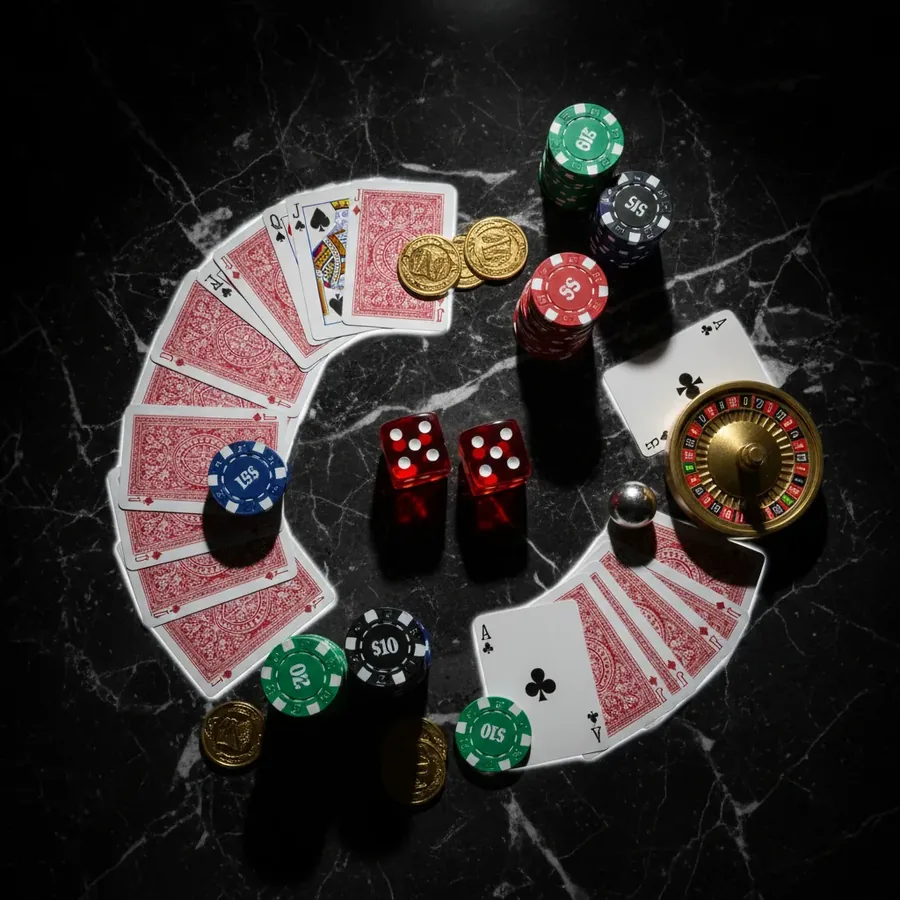
Straight, Split, and Corner: Three Terms Briefly Explained
A Straight bet covers exactly one specific number on the roulette layout, paying out at 35 to 1. This wager carries the highest risk because it requires a precise prediction of the winning sector among thirty-seven options. The house edge remains constant at 2.70% regardless of the payout ratio, as the odds are mathematically fixed by the wheel design.
A Split bet places chips on the line between two adjacent numbers, covering both simultaneously. This wager pays 17 to 1 if either of the two selected numbers hits. The probability of winning doubles compared to a Straight bet, but the payout halves accordingly, keeping the expected value identical.
A Corner bet covers four numbers arranged in a square on the table grid, paying 8 to 1. By targeting four outcomes instead of one, the player increases their hit frequency significantly. Despite the higher coverage, the house edge does not change, remaining at 2.70% for all standard roulette bets.
Video Poker 9/6: What the Two Numbers Mean
The notation 9/6 refers to the payout ratios for a Full House and a Flush in Deuces Wild Video Poker. A Full House pays nine coins for a five-coin bet, while a Flush returns six coins. These generous payouts contribute to an RTP of 100.76%, giving players a mathematical advantage over the house.
This specific paytable structure allows for a positive expected value when playing with optimal strategy. Any deviation from the perfect play reduces the RTP below 100%, turning the advantage back to the casino. The combination of high payouts for mid-tier hands makes this variant unique among mass-market games.
Deuces Wild uses all four deuces as wild cards, enabling hands like Five of a Kind. A Royal Natural pays 800 coins, while Four Deuces awards 200 coins. The 9/6 designation specifically targets the Full House and Flush tiers, which are critical for achieving the super-full RTP figure.
Sic Bo Pays from 1:1 to 180:1
Sic Bo offers a wide range of payouts depending on the specificity of the three-dice prediction. Small and Big bets pay 1 to 1, covering sums of 4-10 and 11-17 respectively. These bets have a house edge of 2.78% to 3.33%, making them the statistically safest options on the table.
Specific Double bets pay 10 to 1 but carry a steep house edge of 18.52%. Predicting an exact pair like two threes requires matching two dice out of three, which is significantly harder than predicting any double. The high payout reflects the low probability of hitting a specific combination.
Specific Triple bets offer the highest payout at 180 to 1 for guessing all three dice match exactly. However, this wager has a house edge of 16.20%, nearly doubling the cost of the safer Small/Big bets. Single Number bets pay between 1 to 1 and 3 to 1 based on matches, with a house edge of 7.87%.
Pass Line in Craps: Process in Four Steps
The Pass Line bet begins with the Come Out roll, where the shooter throws the first dice. Rolling a 7 or 11 results in an immediate win for the player, while 2, 3, or 12 causes a loss. These initial outcomes resolve the bet instantly without establishing a point.
If the shooter rolls 4, 5, 6, 8, 9, or 10, that number becomes the Point. The bet remains active until the shooter either rolls the Point again or rolls a 7. The goal shifts from winning immediately to repeating the Point before a seven appears.
Rolling a 7 after a Point is established is called 'seven-out' and results in a loss for the Pass Line bet. Winning the Pass Line pays even money, or 1 to 1. The house edge on this basic wager is 1.41%, derived from the probability of rolling a seven versus the point numbers.
Game categories at a glance
| Category | Examples | Stakes From | Highlight |
|---|---|---|---|
| Slots | Jammin' Jars, Temple Tumble Megaways, Buffalo Rising Megaways | 0,10 EUR | thousands of titles |
| Table games | Roulette, Blackjack, Baccarat | 0,50 EUR | classic rules |
| Live casino | Ultimate Texas Hold'em, Mega Wheel | 0,20 EUR | real dealers |
| Jackpot games | Mega Moolah, Divine Fortune, Age of the Gods | 0,20 EUR | progressive pools |
| Instant games | Aviator, Plinko, Mines | 0,10 EUR | fast rounds |
| Video poker | Jacks or Better, Deuces Wild | 0,25 EUR | strategy based |
Punto Banco: 5 Percent Commission on Banker Wins
The Baccarat Banker wager in the eight-deck shoe carries a house edge of 1.06 percent, which is the lowest mathematical disadvantage available at the table. This favorable ratio exists because the casino deducts a 5 percent commission on all winning Banker bets to offset the dealer's statistical advantage. Consequently, players receive an effective payout of 0.95 to 1 instead of the standard even money return on successful wagers.
Although the Player bet offers a slightly higher RTP of 98.76 percent with no commission fees, the Banker option remains the superior choice for minimizing losses over time. The 1.24 percent edge on the Player side is marginally worse than the 1.06 percent house advantage on the Banker position despite the fee structure. This small difference means that consistent Banker betting yields better long-term results than alternating between the two main positions randomly.
Players must account for this 5 percent deduction when calculating their potential profits from a winning hand during any session. The commission ensures that the casino maintains its profit margin while still offering the most favorable odds compared to other table games. This structure makes the Banker bet the mathematically optimal strategy for serious players aiming to preserve their bankroll effectively.
Before Double Down: read the open dealer card
In Liberal Vegas Strip Blackjack, doubling down is permitted on any two-card total and even after splitting pairs, which significantly increases player flexibility. The dealer stands on soft 17 and allows re-splitting, creating rules that lower the overall house edge to just 0.28 percent for skilled participants. These liberal conditions allow players to maximize their bet size when holding strong hands against weak dealer upcards like 4, 5, or 6.
Reading the open dealer card is critical because basic strategy dictates specific doubling actions based on that visible face-up value. For instance, doubling on hard 11 against a dealer 2 through 10 yields the highest expected value due to the high probability of drawing a ten-value card. Ignoring the dealer card leads to suboptimal decisions that can increase the house edge by more than one percentage point over hundreds of hands.
The standard deviation of 1.15 indicates moderate volatility, meaning bankroll fluctuations will be noticeable but not extreme during typical play sessions. Players who strictly follow the optimal doubling strategy can achieve an RTP of 99.72 percent, which is among the best in live casino environments. This mathematical advantage relies entirely on making correct decisions based on the visible dealer card rather than guessing or using intuition.
Straight 35:1 Against the Chance of 1 in 37
European Roulette features thirty-seven numbered pockets including a single zero, giving the Straight bet a payout of 35 to 1 against true odds of 1 in 37. This discrepancy creates a constant house edge of 2.70 percent across all interior and exterior wagers regardless of the specific type of bet placed. The consistent edge applies equally to Split, Street, Corner, and Six Line bets, maintaining uniform mathematical expectations throughout the wheel layout.
American Roulette introduces a double zero pocket, increasing the total sectors to thirty-eight and raising the house edge on most bets to 5.26 percent. However, the Five Number Bet covering 0, 00, 1, 2, and 3 carries a much higher house edge of 7.89 percent due to its poor payout ratio. This specific wager is widely considered a trap because it offers the worst value proposition on the entire American roulette wheel compared to other options.
French Roulette mirrors the European wheel with thirty-seven sectors but often includes La Partage rules that refund half the stake on even-money bets when zero appears. Without La Partage, the inner bets retain the standard 2.70 percent house edge identical to the European version without special refunds. Understanding these rule variations is essential for players seeking to minimize their theoretical loss rate per spin over extended playing periods.
RNG Roulette vs. Live Table: Four Clear Differences
Random Number Generator roulette relies on software algorithms to determine outcomes, ensuring each spin is independent and statistically random without physical equipment involvement. The game typically operates faster than live dealer versions because there is no waiting for physical balls to settle or dealers to manage chips manually. This speed allows players to complete many more spins per hour, which theoretically increases the total amount wagered and thus the expected loss rate.
Live dealer tables use physical wheels and real croupiers, providing visual transparency that some players prefer for trust and entertainment purposes. The presence of human interaction and physical hardware introduces slight delays between bets closing and results being announced, reducing the hourly spin count significantly. This slower pace allows for more deliberate decision-making and potentially lower total exposure to the house edge during a fixed-time session.
Betting limits often differ between RNG and live variants, with RNG tables frequently offering lower minimum stakes to accommodate casual players with smaller bankrolls. Live tables may require higher minimum bets to cover the operational costs of studio staff and equipment, limiting accessibility for low-stakes gamblers. Additionally, RNG games offer broader range variations, allowing players to adjust bet sizes more flexibly without the constraints imposed by physical table limits.
Software-based roulette provides instant replayability and access to multiple wheel variants simultaneously, whereas live tables are limited to specific schedules and stream availability. The RNG format eliminates social elements present in live streams, focusing purely on the mechanical outcome of each generated number sequence. Players choosing between these formats should consider whether speed and variety or transparency and atmosphere align better with their personal gaming preferences.
Blackjack flow: cards, decision, payout 3:2
The classic one-deck Blackjack variant offers an impressive RTP of 99.85 percent with a house edge of only 0.15 percent under strict basic strategy adherence. Fewer decks reduce the effectiveness of card counting strategies used by professional players, though the single deck also inherently lowers the house advantage compared to multi-deck shoes. This mathematical efficiency makes it one of the most player-friendly table games available when played with perfect strategic discipline at all times.
A crucial detail is that many modern casinos replace the traditional 3 to 2 payout with a 6 to 5 structure, which drastically increases the house edge to 1.85 percent. This change adds exactly 1.39 percentage points to the casino advantage, making it the single most detrimental rule modification in contemporary blackjack offerings. Players encountering 6 to 5 tables should avoid them entirely as the financial impact outweighs any perceived benefits from other rule concessions.
When a player achieves a natural Blackjack, the 3 to 2 payout awards fifteen units for every ten units wagered, maximizing returns on rare winning events. In contrast, the 6 to 5 structure pays only twelve units for the same hand, significantly reducing the value of hitting the ideal starting combination. This disparity highlights why finding 3 to 2 tables is paramount for serious players aiming to maintain the lowest possible theoretical loss rate over time.
Insurance bets are separate side wagers offered when the dealer shows an ace, paying 2 to 1 if the dealer has a ten-value hole card. Basic strategy universally advises rejecting insurance because the true odds make it a losing proposition unless the player is actively counting cards with a high positive count. Accepting insurance without card counting knowledge increases the house edge substantially and undermines the primary objective of minimizing losses through optimal base game play.
Craps: Pass Line plus Odds lowers the average
The standard Pass Line bet carries a house edge of 1.41 percent, which is derived from an RTP of 98.59 percent across all possible outcomes in Craps. This mathematical baseline applies equally to the Come bet, ensuring consistent risk profiles for players engaging with these primary wagering options on the table layout. Players must understand that this specific edge represents the long-term theoretical return rather than a guaranteed outcome for any single session or betting cycle.
When players attach Odds bets behind their initial wagers, the overall house advantage drops significantly because the Odds portion carries zero percent house edge according to Atlantic City rules. This structural feature allows skilled gamblers to reduce their average cost per hour by maximizing the proportion of their bankroll allocated to these commission-free supplementary wagers during active play sequences.
The combination of the 1.41 percent base edge and the zero-edge Odds creates a unique opportunity for players to minimize their expected loss rate compared to other table games available at Wolfy Casino. Since Sic Bo Small and Big bets carry a higher 2.78 percent house edge, utilizing Craps Odds provides a superior mathematical environment for preserving capital over extended periods of gameplay activity.
Double Down: Doubling Your Bet After Two Cards
Blackjack rules at Wolfy Casino permit doubling down on any two-card hand, including those formed after splits, which significantly increases player flexibility during strategic decision-making phases. This liberal policy aligns with the Liberal Vegas Strip variant that boasts a minimal 0.28 percent house edge when combined with other favorable conditions like soft seventeen standing rules.
The ability to double down after splitting hands directly contributes to achieving the highest possible RTP of 99.72 percent for six-deck Blackjack games offering 3:2 payouts on natural blackjacks. Without this specific rule allowance, the house edge would increase substantially, making the game less profitable for optimal strategy users who rely on doubling opportunities to maximize returns.
Players utilizing basic strategy can exploit this rule to turn unfavorable situations into profitable ones by doubling their initial stake when the dealer shows weak upcards like four, five, or six. This mechanical advantage reduces the casino's mathematical grip from 1.85 percent seen in restrictive 6:5 payout variants to the much more favorable 0.28 percent threshold found in standard three-to-two paying tables.
Game Shows: sectors, multipliers, and bet ranges
Roulette French La Partage offers a reduced house edge of 1.35 percent on even-money bets like Red/Black, where half the stake is returned upon hitting zero instead of losing entirely. This mechanism effectively halves the disadvantage compared to standard European Roulette, which maintains a constant 2.70 percent house edge across all thirty-seven sector placements on the wheel layout.
The Straight bet in European Roulette pays 35:1 but suffers from the full 2.70 percent house edge since La Partage does not apply to inside wagers, creating a significant disparity in value between outside and inside betting categories. American Roulette introduces a Five Number Bet covering zero, double zero, one, two, and three with a punitive 7.89 percent house edge, making it the worst wager available on any roulette variant offered online.
Sic Bo Big and Small bets provide a moderate 2.78 percent house edge with 1:1 payouts, whereas Special Bets like Specific Triples carry exorbitant 18.52 percent edges despite paying 180:1 odds. These multiplier structures demonstrate how game show mechanics prioritize high-volatility entertainment over sustainable long-term player retention strategies through mathematical design.
Craps Odds Bet with 0 Percent House Edge
The Odds Bet in Craps carries absolutely zero percent house edge, meaning the casino retains no mathematical advantage on this specific supplementary wager placed behind the initial Pass Line or Come bet. This unique feature distinguishes Craps from virtually all other casino table games where every single proposition carries some form of built-in house advantage ranging from one to eighteen percent.
When players maximize their Odds wagers, they dilute the overall house edge of their total action toward zero percent, effectively neutralizing the 1.41 percent disadvantage inherent in the base Pass Line wager itself. This mathematical reality makes Craps the most player-friendly table game environment available at Wolfy Casino for those capable of managing larger bankrolls required for substantial Odds attachments.
Baccarat Banker bets offer a comparable low-cost alternative with a 1.06 percent house edge after accounting for the five percent commission charged on winning wagers, providing 0.95:1 effective payouts. While not zero-edge like Craps Odds, this remains superior to the 1.24 percent edge on Player bets and far better than the 14.36 percent edge on Tie bets often found in side markets.
Split 17:1 and Corner 8:1 in Payout Comparison
European Roulette Split bets pay 17:1 while covering only two adjacent numbers, resulting in a 2.70 percent house edge that remains constant regardless of the specific placement on the wheel layout. This fixed disadvantage applies equally to Street bets paying 11:1 and Corner bets paying 8:1, establishing a uniform cost structure for all inside wagers lacking special protections like La Partage.
Comparing these payout ratios to Craps reveals significant differences in risk management, as Craps Pass Line bets pay only 1:1 but benefit from subsequent Odds bets carrying zero percent house edge entirely. The Roulette Inside bets lack any equivalent mechanism to reduce the 2.70 percent mathematical grip, forcing players to accept higher long-term losses for similar nominal payout percentages on successful hits.
Blackjack Insurance pays 2:1 but carries a prohibitive 7.47 percent house edge, making it mathematically inferior to both Roulette Split bets and nearly all Craps propositions except potentially complex multi-roll scenarios. This stark contrast highlights how payout ratios alone mislead players about true cost, as the underlying probability calculations determine actual profitability rather than superficial multiplier appearances on the betting grid.
Contact
Live - online chat
Banking









Providers












wolfy casino 2024